

Written by Julia Keating, Solicitor at Pippa Colman Family Law | Updated 19 Nov. 2026
Going through separation can be painful and daunting to navigate. One of the most important considerations for parents who have separated is determining what arrangements are appropriate for their children.
If you have recently separated or have been separated for some time, you’ve likely given some thought already as to the arrangements that may be in place or that you think should be in place. Any parenting arrangements put in place, either formally or informally, should focus on the best interests of your children as the paramount consideration.
Two common ways of formalising parenting arrangements are through either a:-
Parenting Plan, including Consent Orders; or
Parenting Order.
Whilst both have some underlying similarities, understanding the difference between the options can help parents make informed decisions about the arrangements most suitable for their children and family, and which will maintain stability for everyone involved.
What is a Parenting Plan?
A Parenting Plan is a written agreement between a child’s parents that sets out arrangements for the care, welfare and development of their children. Under the Family Law Act 1975 (Cth) a Parenting Plan must be in writing, signed, and dated by both parents.
Parenting Plans are voluntary and can be tailored to suit the particular needs and circumstances of each family. Depending on the children’s ages and the parent’s circumstances’, the plan may address (for example):-
Where the children will live and the time they will spend with each parent, including school holidays and special occasions;
How decisions concerning education, health, religion and other significant aspects of the children’s lives will be made;
Arrangements for telephone time and video communication between the children and each parent;
How parents will communicate with each other, and resolve disputes;
Extracurricular activities;
Emergency arrangements;
Overseas travel and passports.
A well drafted and prepared Parenting Plan should be practical, clear and detailed to minimise misunderstandings/disputes and not be confusing to read. Most importantly any arrangements should reflect a child’s individual needs, giving careful consideration to their developmental stage, schooling, relationships, medical needs (including mental health), and promote stability.
One of the main advantages of a Parenting Plan is its flexibility. Parents who communicate effectively and are willing to cooperate may find that a plan provides an appropriate framework for co-parenting without the time and significant expense associated with court proceedings.
Parenting Plans can be particularly useful in the early stages of separation, when living arrangements and routines may still be evolving or uncertain for parents and children. They can also be reviewed and updated by agreement as children grow older or family circumstances change.
Is a Parenting Plan legally binding?
Parenting Plans are not legally enforceable in the same way as Parenting Orders. If one parent does not follow the agreed arrangements, the other parent generally cannot seek enforcement of the plan through the Court. For families experiencing significant conflict, poor communication, family violence or ongoing disagreement, a parenting plan may not provide sufficient certainty or protection. In these circumstances, obtaining legal advice about more formal arrangements may be appropriate.
What is a Parenting Order?
A Parenting Order is an Order made by the Federal Circuit and Family Court of Australia, or another Court with the relevant jurisdiction, that determines parenting arrangements for a child.
Parenting Orders may be made by consent, where parents reach an agreement and seek the Court's approval, or following court proceedings where agreement cannot be reached and a Judge makes a final determination of what the arrangements will be.
Depending on the circumstances, an Order may deal with:-
Where a child will live and the time they will spend with each parent or other significant people;
The allocation of parental responsibility and how decisions about major long-term issues will be made;
Communication arrangements, school holidays and special occasions;
Other matters necessary to address the child's care, welfare and development.
It is not unusual that Parenting Plans and Parenting Orders give consideration to the same matters in respect of arrangements for children.
Parenting Orders are legally binding as they are an Order of a Court. A parent who fails to comply with an Order without a reasonable excuse may face legal consequences. This can provide greater certainty and accountability where parents have difficulty reaching or maintaining agreement.
Can a Parenting Order be changed
Parenting Orders are however generally less flexible than Parenting Plans. Although parents may agree to change practical arrangements, they should obtain legal advice before departing from existing orders. A Parenting Order can be formally varied by a subsequent court Order, and the Court must apply the relevant statutory requirements when considering an application to change any existing Order.
Parenting Plan or Parenting Order: Which Is Best for My Family?
The most suitable option for a family will depend on their circumstances, the children's needs and the parents' capacity to cooperate and co-parent.
A Parenting Plan may be appropriate where parents have a reasonably cooperative relationship, can communicate respectfully and are able to adapt arrangements as circumstances change. A Parenting Order may be preferable where greater certainty is required, disagreements persist, there is family violence, or there is a high risk that agreed arrangements will not be followed. In some cases, parents can reach an agreement and obtain consent orders without the need for a contested hearing which can take considerable time and expense to reach.
The Court's paramount consideration is the best interests of the child, in accordance with section 60CA of the Family Law Act 1975 (Cth). The statutory framework in section 60CC guides the Court's assessment of those interests. Each family's circumstances are different, and arrangements should not be based on what is most convenient for either parent.
It is also important to recognise that parents are not the only people who may seek parenting orders. Grandparents and other people concerned with a child's care, welfare or development may be able to apply, depending on their circumstances and the applicable legal requirements. Independent legal advice is particularly important for non-parent applicants.
What Should a Parenting Plan or Parenting Order Include?
Whether you are preparing a parenting plan or considering consent orders, careful attention to detail can help prevent future disputes.
You should consider addressing (regardless of whether you are entering in a Plan or Order):-
School-term arrangements;
Holidays;
Birthdays and significant family occasions;
Decision-making about education and major medical treatment;
Communication between the children and each parent;
Extracurricular activities; and
Arrangements for domestic or overseas travel, including passports and consent requirements.
Clear provisions will minimise the risk of future disputes or misunderstandings arising.
Choosing between a parenting plan and parenting orders is an important decision that can have lasting implications for children and their parents. Early legal advice can help identify the available options, clarify rights and obligations, and establish arrangements that are practical, appropriate and focused on the children's best interests.
Below is a quick reference guide:
Parenting Plan vs Parenting Order
Two common ways to formalise parenting arrangements after separation, and how they differ.
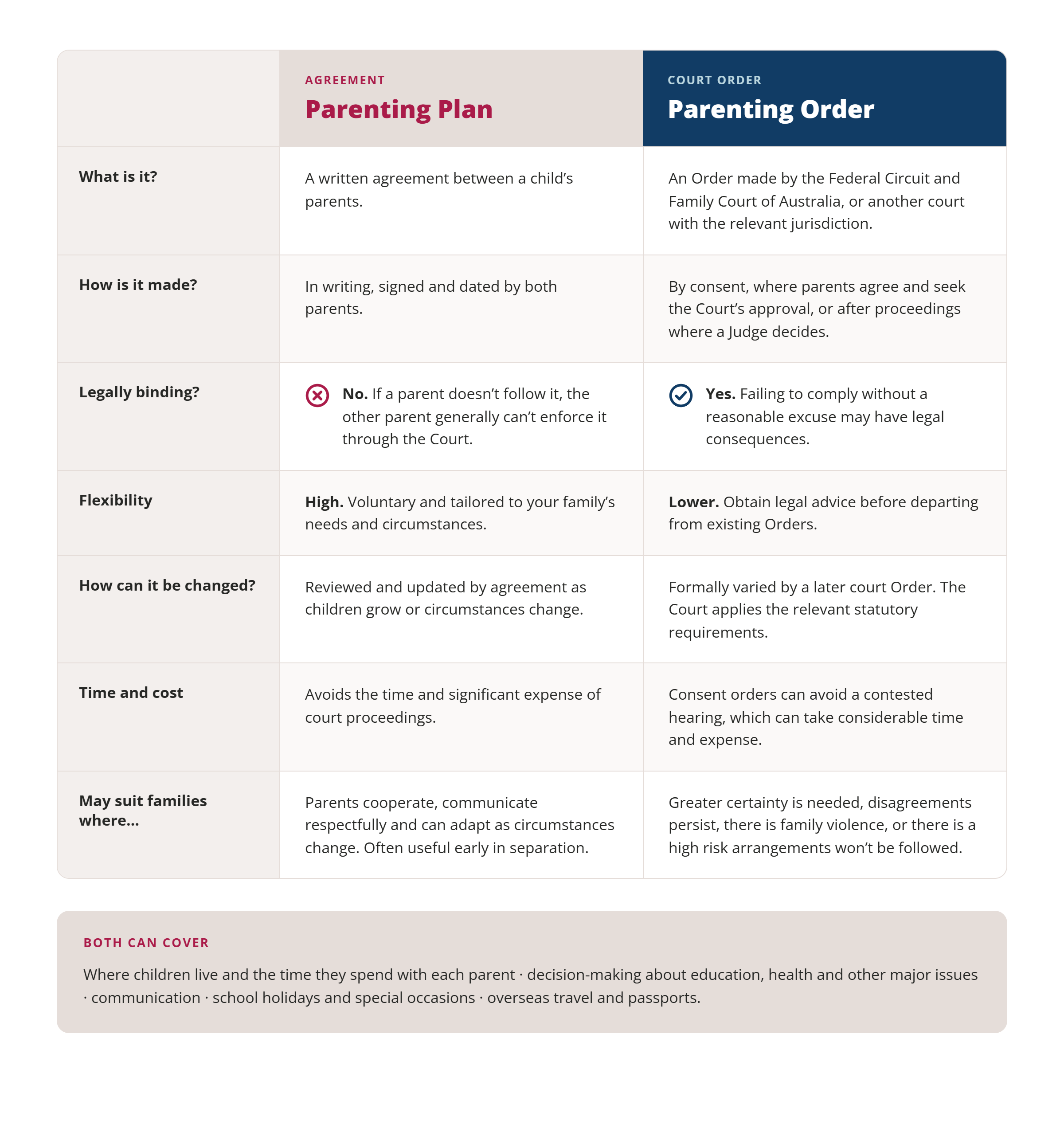
In every case, the paramount consideration is the best interests of the child (section 60CA, Family Law Act 1975 (Cth)).
Frequently Asked Questions
-
No. A Parenting Plan generally can’t be enforced by the Court.
-
Yes. A parent who fails to comply without a reasonable excuse may face legal consequences.
-
Yes. If parents agree, they can seek the Court’s approval of consent orders and avoid a contested hearing.
-
A Parenting Plan can be updated by agreement. A Parenting Order can be formally varied by a later court Order.
-
The best interests of the child are the paramount consideration, under section 60CA of the Family Law Act 1975 (Cth).
-
They may be able to, depending on their circumstances. Independent legal advice is particularly important.
Getting Advice About Parenting Arrangements
Pippa Colman Family Law assists families across the Sunshine Coast, Townsville and surrounding areas with parenting plans, consent orders and complex parenting matters.
Contact Pippa Colman Family Law today to discuss how we can help you.
Important Disclaimer
The above information is general in nature and provided for educational and informational purposes only. It is not legal advice and should not be relied on as such. Every situation is different, and you should seek independent legal advice before making decisions about your own circumstances.